← Back to Our Work

Highland

When a longtime iSpec client purchased a 1940s ranch near Upper Arlington in Columbus, she already knew who to call. The house had the bones of a solid mid-century build — cinder block exterior walls, simple layout, good location — but the bathroom told a different story. A previous owner had attempted a DIY renovation, building new finishes directly over the home's original bathroom rather than doing the work correctly. From the surface it looked like a finished space. Underneath, nothing was right.

The homeowner didn't want a patch job. She wanted the bathroom taken down to the structure and rebuilt with high-end finishes, proper systems, and a layout that worked for how she lives. What started as a bathroom gut remodel expanded once the walls came open — the home's original rough plumbing was deteriorated and leaking at the drains, requiring replacement throughout the house. iSpec took on the full scope, working directly with the owner through every design decision to build the space she'd envisioned. The result is a bathroom that doesn't just look like it belongs in a different house — it feels like it belongs in a different category entirely.
Before


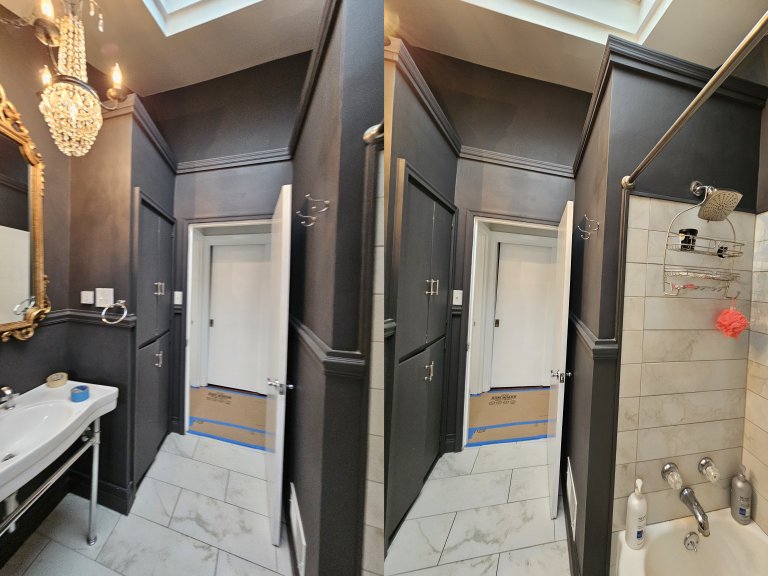
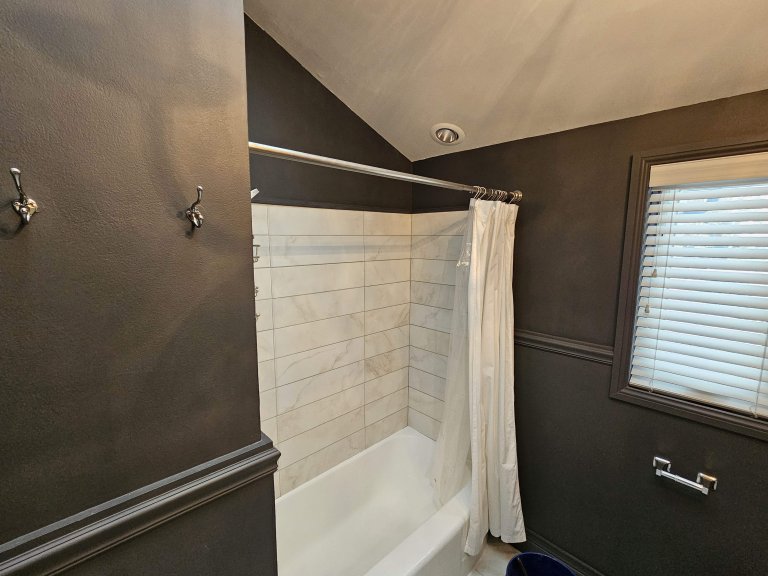
Behind the previous owner's dark-painted walls and decorative finishes, the original 1940s bathroom was still buried underneath. When demo started, the full scope of the problem came into focus. The DIY renovation had been layered directly over the original construction — framing over framing, finishes over finishes — without addressing any of the underlying structure or systems.

The quality of the previous work told its own story. Grout was cracked throughout. Brick mold had been used as door trim, and door casing had been repurposed as crown molding. Behind the walls, the electrical was worse — extension cords had been cut and wired in place of Romex. None of it was to code, and none of it was salvageable.

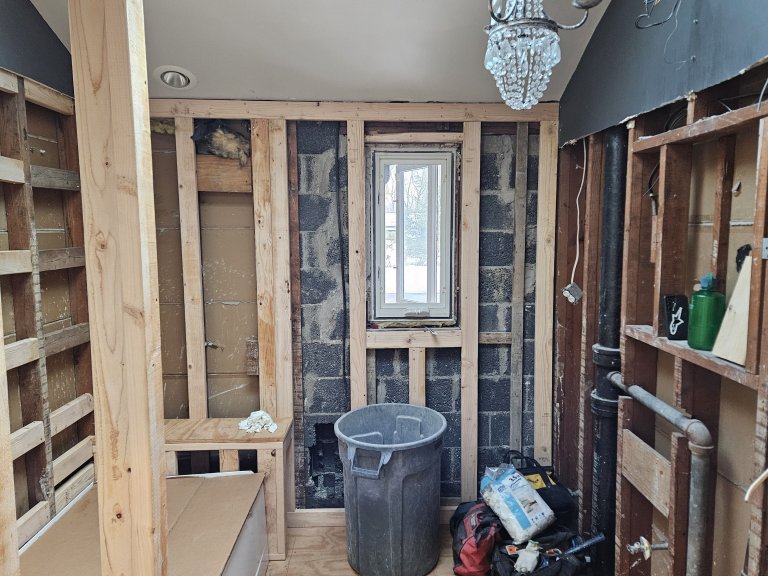
Once both layers were removed and the walls were open to the cinder block, a bigger problem showed itself. The home's original rough plumbing — drains original to the 1940s build — was deteriorated and starting to leak. What began as a bathroom remodel now included a whole-house drain replacement.

During


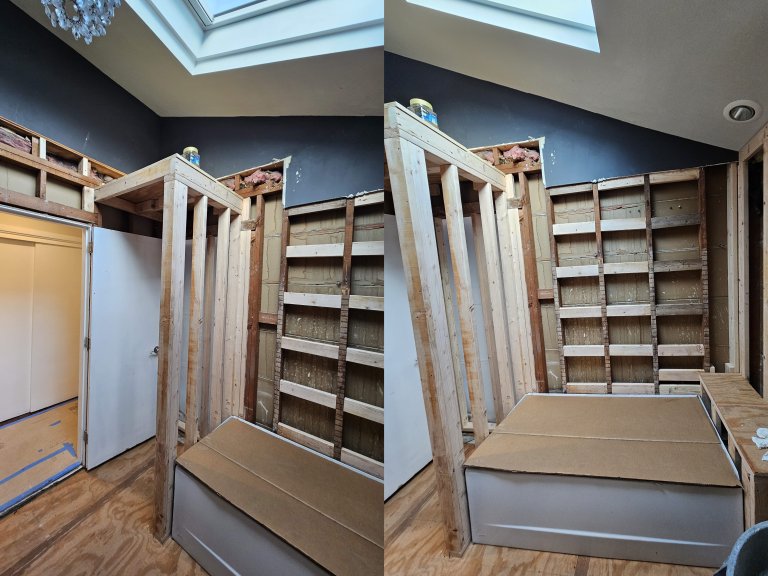
Demo was a two-stage process. The DIY overbuild came out first, then the original 1940s bathroom underneath. Everything was stripped back to bare studs, joists, and cinder block.

Structural and systems work came next. The home's deteriorated rough plumbing was replaced throughout the house — new drain lines to replace the failing originals. In the bathroom, the tub was relocated to a new position, which meant rerouting both supply and drain lines to the new layout. All electrical was pulled and replaced with proper Romex runs on dedicated circuits for the vent fan, uplighting, sconces, and recessed lighting.

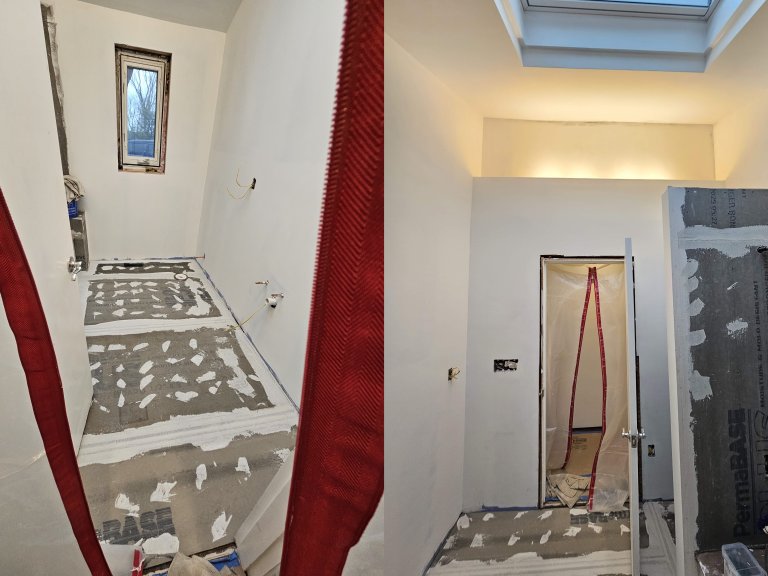
Because the home is a 1940s ranch with cinder block exterior walls, the walls had to be furred out with new framing to create a cavity for insulation and a flat plane for drywall. New subfloor went down over the joists, with mortar work to level and stabilize the substrate for tile. PermaBase cement board was installed in all wet areas — the tub surround, shower walls, and tub deck. Drywall closed up the remaining walls and ceiling, which was rebuilt around the existing skylight with a new soffit designed to conceal both uplighting and the ventilation fan.

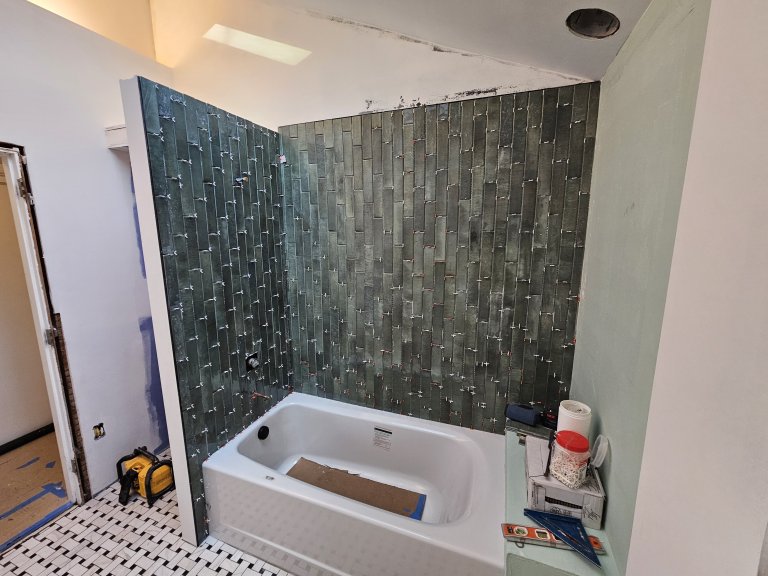
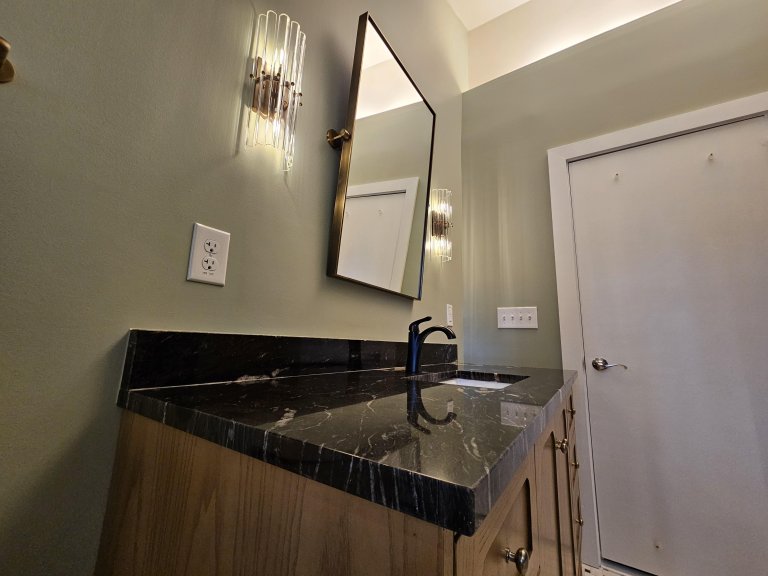
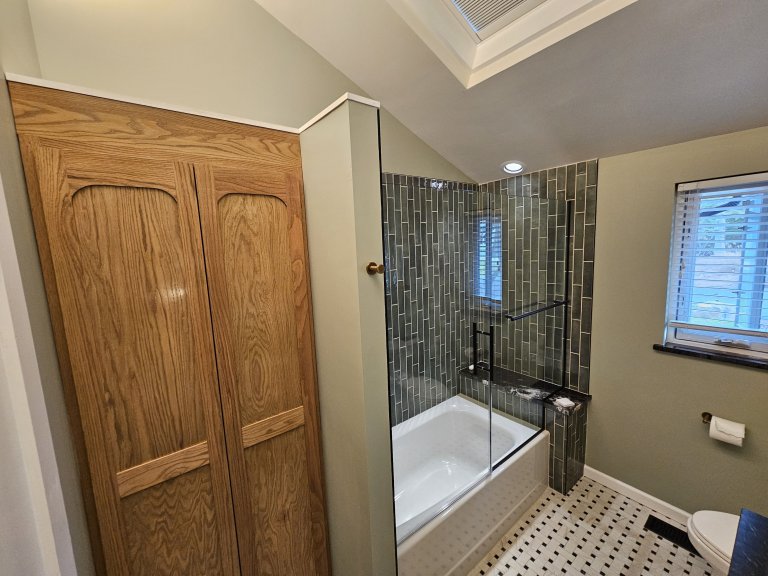
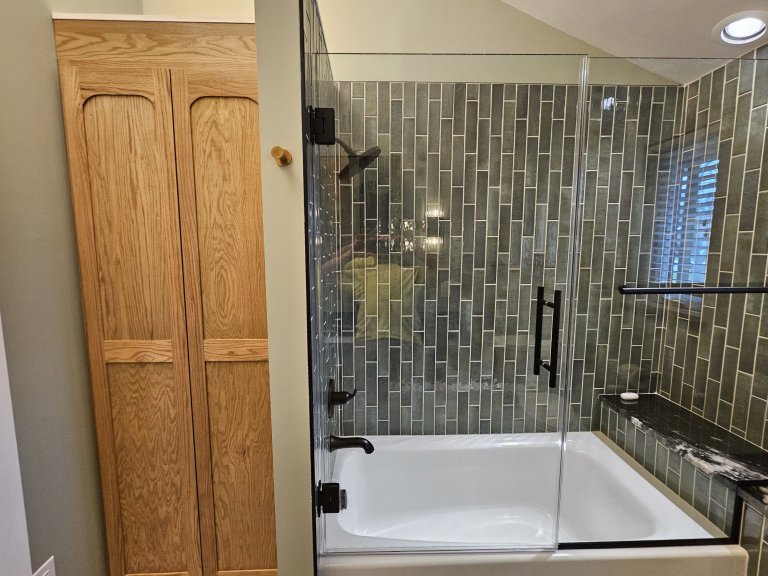
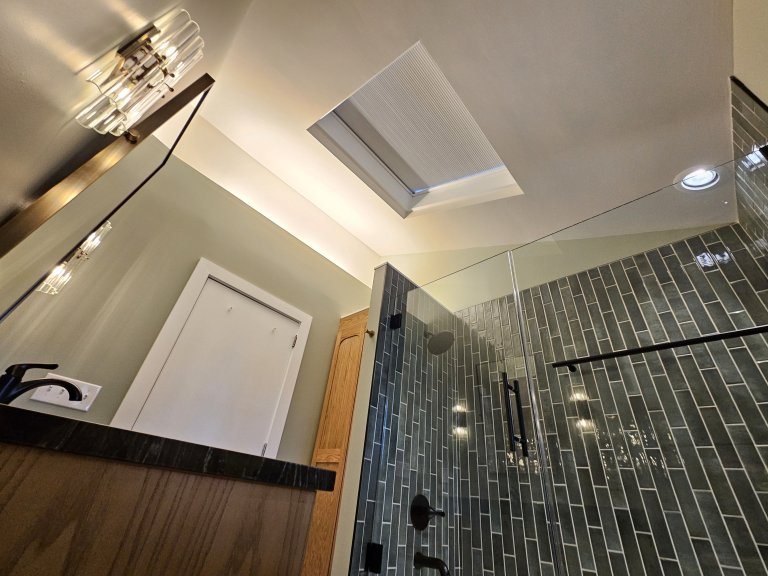
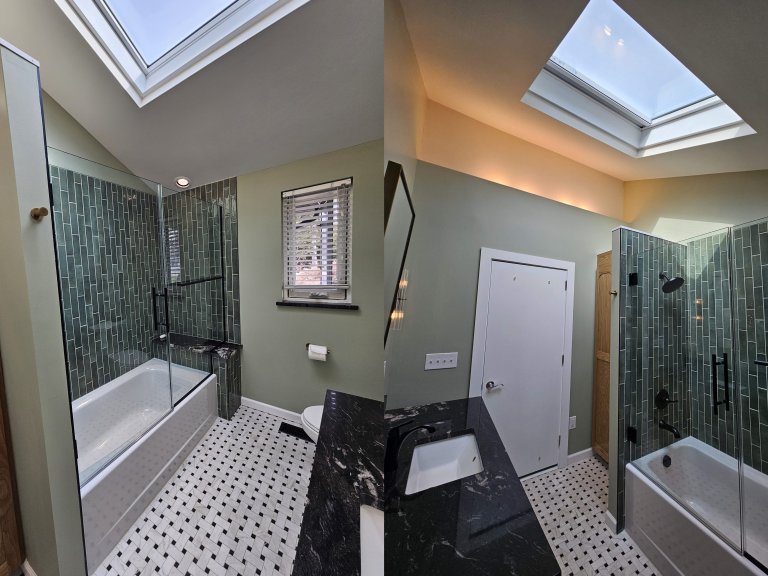
Finish work followed in sequence. The tub surround received floor-to-ceiling green vertical subway tile. A granite seat was built into the end of the tub enclosure, with matching granite on the vanity countertop and windowsill — all cut from the same stone. The floor was laid in white and black basketweave marble mosaic. A frameless glass enclosure with matte black hardware was fitted to the tub opening. The built-in oak linen cabinet was installed with arched panel doors and adjustable shelving. Crystal glass tube sconces, a brass-framed tilting mirror, and matte black fixtures finished the room.

After


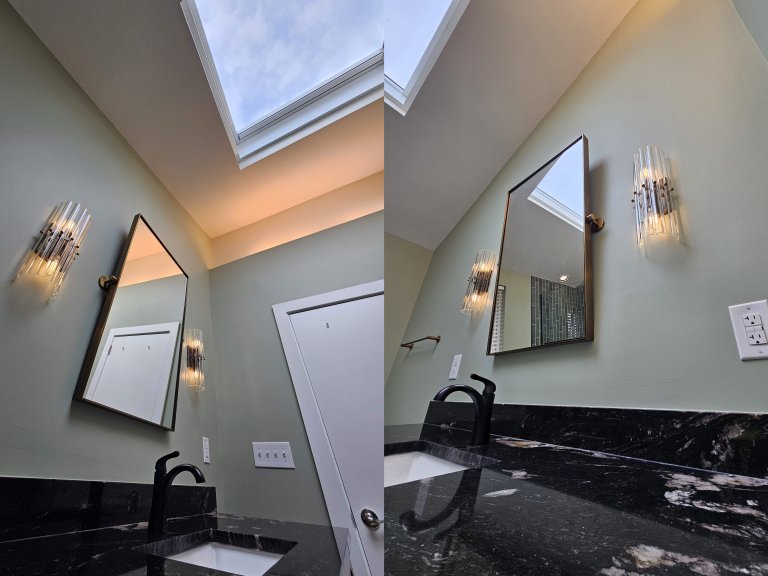
The finished bathroom feels nothing like what came before it. Natural light pours through the skylight, catching the gloss of the green subway tile and reflecting off the frameless glass enclosure. The granite — dark, heavily veined, and dramatic — ties the vanity top, shower seat, and windowsill together as a single design statement. Matte black shower fixtures and faucet contrast against the sage green walls, while crystal glass tube sconces and a brass-framed tilting mirror bring warmth to the vanity wall.

The built-in oak linen cabinet, fitted between the entry door and the shower wall, provides full-height storage without eating into the floor plan. Its arched panel doors and natural wood grain give the room a custom furniture quality that most bathrooms never achieve. Above, concealed uplighting in the skylight soffit washes the vaulted ceiling with ambient light, and a hidden vent fan keeps the room clear without breaking the clean ceiling lines. The white and black basketweave marble floor anchors the whole space.

This was a collaborative build from start to finish. The homeowner chose every finish, and iSpec built the framework to make it all work — from the joists and plumbing up through the last piece of hardware. What was once a bathroom buried under layers of someone else's shortcuts is now the room she built her dream around.